Canada's Housing Market in 2026: Falling Prices, Frozen Sales, and Whether the New 13% HST Rebate Can Turn Things Around
Published on March 29, 2026
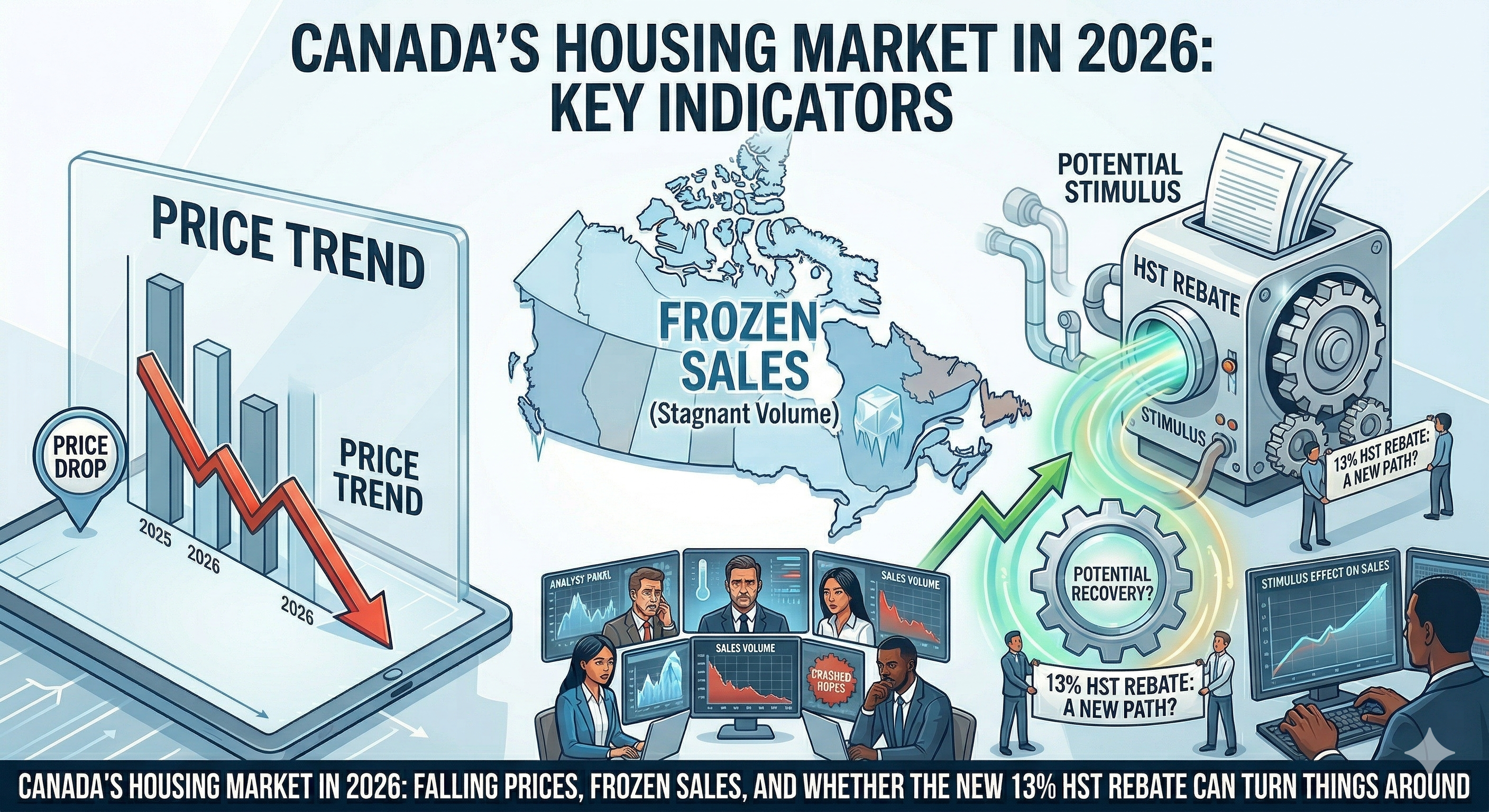
Canada's Housing Market in 2026: Falling Prices, Frozen Sales, and Whether the New 13% HST Rebate Can Turn Things Around
Canada's housing market was supposed to be different this year. After several difficult years of climbing interest rates, squeezed affordability, and buyers sitting on the sidelines, 2026 was meant to be the rebound. Rate cuts had arrived. Prices had softened. Pent-up demand had been building for years. The conditions were there for a recovery.
It has not happened. Not yet, anyway. And the reasons why reveal something important about where Canadian real estate actually stands today, what is realistically coming next, and whether the new combined 13 percent HST rebate on new homes announced in late March has any real chance of changing the picture.
The Numbers Tell a Difficult Story
The February 2026 housing statistics confirmed what buyers, sellers, and real estate professionals had already been feeling on the ground. National home sales came in at just 30,244 transactions, a 6.7 percent year-over-year decline, according to the Canadian Real Estate Association. That is not a rounding error. That is a market where buyers are simply not showing up at the pace anyone expected.
The national benchmark home price sat at approximately $661,000 in February, down 0.5 percent from January and down 5 percent from a year earlier. The MLS Home Price Index recorded its 14th consecutive monthly decline in January, with the January drop of 0.9 percent being the steepest single-month fall since late 2023, according to RBC Economics. In other words, the slide in prices is not new and it has not stopped.
The city-level data is especially telling. Toronto area home prices fell 7.9 percent year-over-year as of February 2026, with the average price sitting just over $1 million. Vancouver was down 6.8 percent over the same period. Hamilton experienced its slowest home sales in December since 2010. Ottawa entered negative price territory for the first time in this cycle. By February 2026, five major Canadian cities were simultaneously recording year-over-year price declines, a situation that has not been seen in recent memory.
The Prairie markets and parts of Quebec and Atlantic Canada have held up relatively better, supported by stronger relative affordability and tighter supply. But those pockets of resilience cannot disguise the reality that Canada's two largest, most expensive housing markets are in a clear and ongoing correction.
Why Are Buyers Still Sitting on the Sidelines?
This is the question that keeps industry observers up at night. Interest rates have come down substantially. The Bank of Canada cut its overnight rate from a peak all the way to 2.25 percent. Mortgage rates followed. By any traditional model, lower rates should be pulling buyers back into the market. And yet here we are, with sales declining anyway.
The honest answer is that rates are not the primary problem right now. The bigger issues are confidence, employment uncertainty, and the lingering effects of the U.S.-Canada trade dispute.
A Royal LePage survey found that approximately 49 percent of Canadians who had been considering a home purchase had put their plans on hold because of the tariff situation with the United States. Of those, 37 percent cited concerns about the cost of living, 30 percent mentioned the general sense of political and economic uncertainty, and 14 percent said they were simply waiting because they expected prices to fall further. When nearly half your potential buyer pool is voluntarily sitting out, no amount of rate cutting fixes the problem quickly.
CREA's senior economist Shaun Cathcart described the situation plainly, saying that what started as a market story about tariff uncertainty has become a story about actual economic fallout. What was supposed to be a rebound year has become a year of treading water at best. Southern Ontario has been the hardest hit, where home resales were down 21 percent in a two-month window, and British Columbia was not far behind at 17 percent. Those are steep, rapid declines in the country's most expensive markets, where affordability was already stretched to the limit before any of this started.
Adding pressure from the supply side, new listings have also been declining, which in a normal market would support prices. But when buyer demand is as weak as it currently is, even a falling supply of listings cannot stop prices from drifting lower. Sellers are increasingly facing the reality that waiting for a better price may simply mean waiting a long time.
The New 13% HST Rebate: What It Is and Who It Helps
Into this environment, the Ontario government and the federal government announced in late March 2026 one of the most significant housing affordability measures in recent Canadian history. Starting April 1, 2026, for a period of one year, eligible buyers of new homes in Ontario will receive a rebate on the full 13 percent HST they would otherwise pay on their purchase.
Here is how it works in practical terms. On a new home valued at $1 million or less, a buyer could save up to $130,000 in combined federal and provincial tax. That breaks down as the federal GST rebate of up to $50,000, covering the 5 percent federal portion, combined with the Ontario provincial rebate of up to $80,000, covering the 8 percent provincial portion. For a $1 million new home, this effectively wipes out the entire HST bill.
For homes priced between $1 million and $1.5 million, the rebates phase down proportionally but remain substantial. The rebate structure tapers further between $1.5 million and $1.85 million, and homes above $1.85 million receive a reduced amount. Notably, and this is a significant expansion from previous programs, the rebate is not limited to first-time buyers. Whether you are purchasing your first home, your second, or your tenth, as long as it is a newly constructed property, you are eligible for the full benefit during this one-year window.
Separately, the federal government had already passed a broader first-time buyer GST rebate allowing eligible individuals to recover up to $50,000 on qualifying new home purchases. When combined with Ontario's new provincial measure, the total potential saving of $130,000 represents a dramatically better outcome than the previous GST/HST rebate system, which had been capped at just $6,300 for most buyers.
The Ontario government estimated the one-year measure will cost the province approximately $2.2 billion and could stimulate an additional 8,000 housing starts, potentially supporting around 21,000 jobs and adding approximately $2.7 billion to the province's GDP growth. The province clearly sees the construction sector, which is already in a serious downturn with projects shelved and thousands of jobs at risk, as the primary target of the policy.
Will It Actually Work? The Honest Assessment
The answer depends very much on which problem you think the HST rebate is solving, and which problems it is not.
On the supply and construction side, the case for the rebate is reasonably strong. New home construction in Ontario has been suffering, not just because of soft buyer demand but because developers cannot pencil out projects at current land costs, construction costs, development charges, and tax burdens. Removing 13 percent of the carrying cost on the buyer side makes newly built homes more competitively priced against the resale market, which should in theory pull some demand toward new construction and give developers more confidence to break ground on stalled projects. Industry insiders said immediately after the announcement that the rebate would help get trades back to work, and that is probably accurate.
On the broader housing demand side, the picture is more complicated. The rebate only applies to new builds, not to the existing resale market where the majority of transactions take place. A buyer looking at a resale condo in Toronto does not receive any benefit from this program. That means the policy is unlikely to move the needle much on the headline sales and price statistics that dominate the housing market conversation, at least not in the near term.
More importantly, the rebate does not address the real reason buyers are staying out of the market right now. People who are worried about their job security in an uncertain trade environment are not going to be convinced to commit to a $900,000 new home purchase because the tax bill is lower. The confidence problem, the employment uncertainty problem, and the affordability problem relative to wages are all still very much present. As Nicole Lechter of RSM Canada noted, rate cuts have not driven an uptick in home buying because potential buyers are sidelining themselves over much broader concerns than just the monthly mortgage payment.
CMHC's own 2026 outlook puts it diplomatically but clearly: while overall home demand is subdued, national home sales are projected to pick up temporarily in 2026, led by Ontario and British Columbia, but their rebound is mostly due to pent-up demand from recent weakness, not a sustained recovery. The HST rebate may pull forward some of that pent-up demand in the new build segment, but it is not a structural fix for the affordability challenge that has been building for the better part of a decade.
One construction industry voice quoted after the announcement framed it well: the rebate is structured like a pilot program, and that is smart, because nobody really knows how effective it will be in a market this uncertain. Even the people who stand to benefit most from increased construction activity are tempering their expectations.
Where Are Prices Heading From Here?
The regional picture matters enormously here because Canada's housing market is not one market, it is many.
In Toronto and Vancouver, where prices have already fallen from their 2022 peaks by as much as 25 percent in some segments, further declines are possible in the near term. Stretched affordability relative to incomes, slowing international immigration that previously drove demand, and weak buyer confidence all point toward continued softness. The benchmark price of around $661,000 nationally sounds modest until you remember that in these cities the numbers are dramatically higher and the ratio of price to household income remains among the worst in the developed world.
Royal LePage forecast that condominiums nationally would decrease another 2.5 percent on a year-over-year basis to approximately $563,918 by Q4 2026. The condo market, particularly in Toronto, has been the most vulnerable segment given the wave of investor-owned units coming onto the market simultaneously.
CREA's January 2026 forecast projected that national home sales would increase 5.1 percent for the full year, driven largely by Ontario and British Columbia where sales have the most room to recover. The national average price was forecast to reach approximately $698,881 in 2026, representing a 2.8 percent annual gain. But those forecasts were made before the latest round of geopolitical and economic uncertainty deepened in February and March, and most analysts would now describe those numbers as optimistic given what has happened since.
True North Mortgage's March 2026 forecast notes that the national market continued to decline in February across all three headline metrics: sales, average prices, and new listings. The trend heading into spring 2026 is not one of recovery, and spring is supposed to be the strongest season for Canadian real estate.
The CMHC has taken a more cautious view than the private real estate industry, noting that domestic demand and household spending are expected to remain weak from 2026 through 2028, with unemployment staying elevated and limiting the pool of buyers who are both willing and financially able to purchase. That is a sobering three-year horizon from the country's national housing agency.
What Should Buyers, Sellers, and Investors Be Thinking Right Now?
For anyone buying a newly constructed home in Ontario, the timing from April 1 onward represents a genuinely exceptional window. Savings of up to $130,000 on eligible new builds are real and material, and the one-year clock on the rebate creates a legitimate incentive to act before the program expires. If you were already planning to purchase a new home in 2026, moving forward sooner rather than later makes clear financial sense. The program is open to all buyers, not just first-timers, which widens the eligible population significantly.
For buyers interested in the resale market, the calculus is different. Prices are softening in most major markets, which improves affordability somewhat, but the broader economic uncertainty that has been keeping buyers away has not resolved. The question of whether to buy now or wait depends heavily on personal circumstances, including job security, the duration of your planned ownership, and whether you are buying to live in the home or as an investment. A home purchased and held for 10 years looks very different from one purchased and sold in two or three.
For sellers, the environment is challenging. Pricing realistically from the start matters more than it has in years. The days of listing above market and waiting for competing offers are largely gone in Toronto, Vancouver, and Hamilton. Buyers have negotiating power that they have not had in a long time, and they are using it. If you need to sell, work with pricing that reflects where the market actually is today, not where it was in 2021 or 2022.
For investors and developers, the HST rebate changes the math on new construction projects in a meaningful way. Whether it is enough to unlock stalled condo towers and subdivision projects depends on the broader cost picture, including land, construction labour, and development charges, which the rebate does not address. But it is a real improvement in economics, and projects that were borderline unworkable may now clear the hurdle.
The Bottom Line
Canada's housing market in 2026 is in an unusual and uncomfortable position. The interest rate environment has improved significantly. Prices have corrected meaningfully from their peak. The fundamental case for a gradual recovery is there. But the confidence and employment conditions that buyers need to actually pull the trigger on the biggest purchase of their lives are being undermined by economic uncertainty that has nothing to do with mortgage rates or home prices directly.
The new 13 percent HST rebate on new homes is genuinely good policy in the sense that it removes a real cost barrier and will help the construction sector at a time when it is struggling badly. For eligible buyers of new builds in Ontario, it creates savings that can meaningfully change the affordability calculation. But it is not a magic cure for a market that is waiting on confidence, employment stability, and a clearer economic horizon before buyers return in force.
The housing market's recovery will come. Canada's long-term fundamentals, including population growth, chronic undersupply relative to demand over a multi-decade horizon, and the aspiration of homeownership that remains deeply embedded in Canadian culture, all still point in the same direction. But the timing is harder to call than it looked a year ago, and anyone claiming certainty about where prices will be in six or twelve months is not paying close enough attention to how quickly conditions have shifted in 2026.
This article is for general informational purposes only and does not constitute financial, tax, or real estate advice. Please consult qualified professionals before making any real estate or investment decisions.
The Vantage Corporate Team
Strategic Financial Planning for Canadian Business Owners
vantagecorporate.ca