Markets on a Roller Coaster: What Oil Uncertainty Is Doing to Inflation and the Interest Rates That Were Supposed to Save Us
Published on March 29, 2026
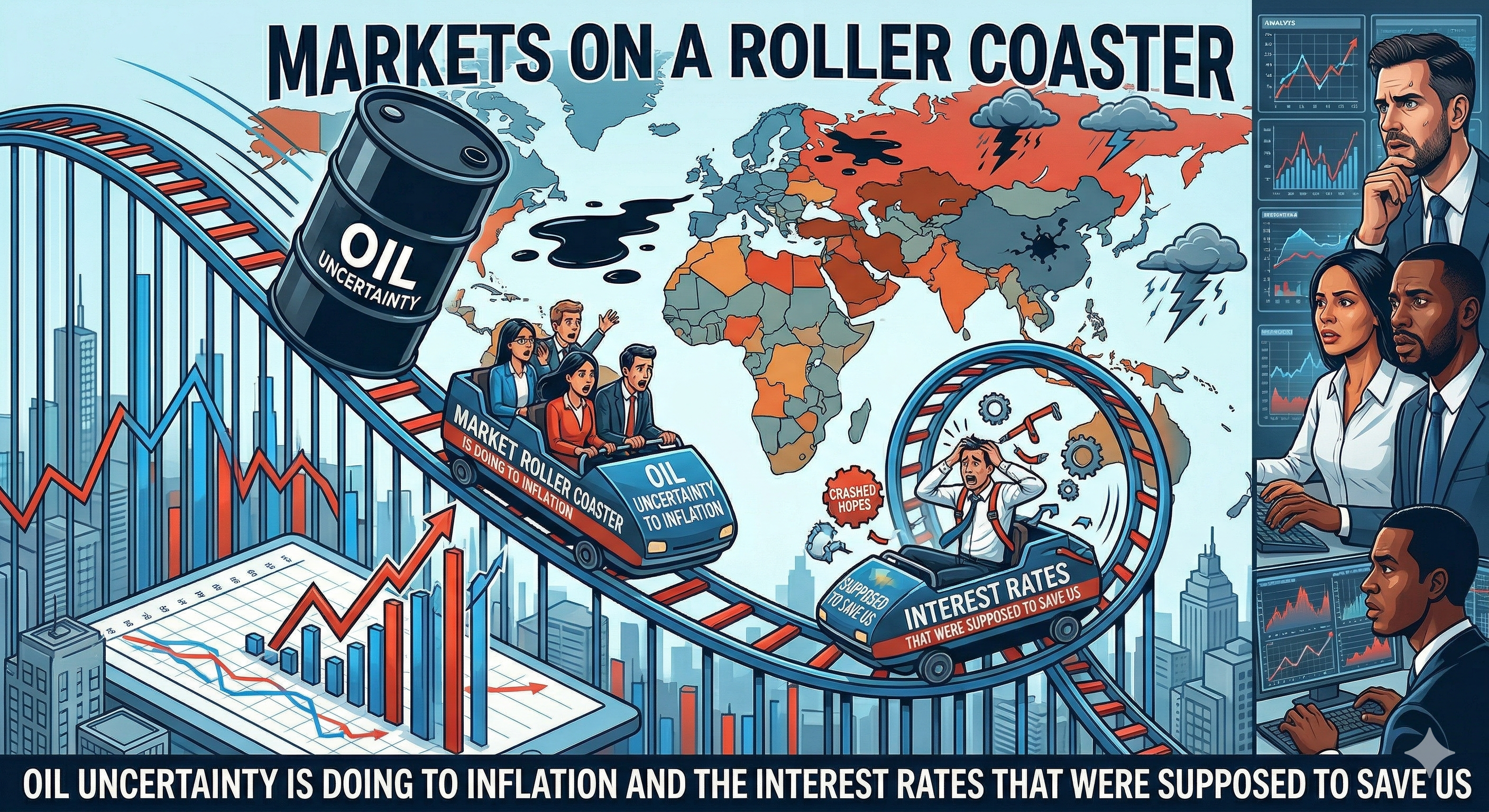
Markets on a Roller Coaster: What Oil Uncertainty Is Doing to Inflation and the Interest Rates That Were Supposed to Save Us
At the start of 2026, most investors and business owners were operating on a fairly reasonable assumption. Inflation had cooled. Central banks had done their job. Rate cuts were coming, the economy would get its soft landing, and markets would carry on climbing. That story is now considerably more complicated, and the reason, more than any other single factor, is oil.
The wild swings in energy prices since January have rattled financial markets, reshuffled inflation forecasts, and put both the Bank of Canada and the U.S. Federal Reserve in a position nobody wanted them to be in: stuck between a slowing economy and an inflation number that is heading in the wrong direction. For Canadian businesses and investors, understanding how we got here and where things might go matters a great deal right now.
The Market Ride Nobody Signed Up For
Coming into 2026, the S&P 500 was sitting less than 2 percent off its all-time high. Sentiment was cautious but not fearful. Then the Middle East conflict deepened, the Strait of Hormuz became a daily headline, and oil prices started doing things that energy markets had not done in years. Brent crude climbed above $100 per barrel. The CBOE Volatility Index, widely known as Wall Street's fear gauge, pushed toward historical highs. Futures for the S&P 500, the Nasdaq, and the Dow all fell roughly 1 percent overnight in a single session in mid-March as crude topped $105 intraday.
The Global Uncertainty Index reached levels that surpassed readings from COVID-19, the 2008 financial crisis, and the dot-com collapse. That is not a minor observation. When markets price uncertainty that extreme, it tends to produce erratic, stop-start behaviour across asset classes, and that is precisely what has been happening.
Energy shares have been the obvious bright spot. Oil field services companies like Baker Hughes and Halliburton surged more than 4 percent in a single session in mid-March, and energy ETFs hit new 52-week highs. But elsewhere, the picture has been messy. The broader consumer discretionary sector wobbled as investors began doing the math on what $100 oil means for household spending. Bond yields climbed. The Dow fell harder than the Nasdaq on days when crude spiked because it carries more exposure to companies sensitive to input costs and consumer wallets.
Bank of America analysts pointed out something that should give investors pause: the S&P 500 currently trades at a higher premium relative to oil prices than at almost any point since the 1960s, with only two exceptions being the COVID period when oil went briefly negative, and the peak of the dot-com bubble. That kind of disconnect between equity valuations and energy costs cannot persist forever. Either oil comes back down, or stocks have some adjusting to do.
Inflation Was Supposed to Be Under Control
Here is the uncomfortable truth about inflation in 2026. For most of the past year, the story was genuinely encouraging. Canadian CPI came in at 1.8 percent in February. The Bank of Canada had brought its policy rate down from a peak to 2.25 percent through a series of cuts starting in June 2024. Core inflation measures were easing. Things were moving in the right direction.
Then oil prices surged roughly 37 percent in the weeks following the escalation of conflict involving Iran, and the math changed fast.
TD Economics estimated in mid-March that the oil shock alone could add approximately 0.8 percentage points to Canada's headline CPI, with a peak inflation reading around 3.8 percent in the second quarter of 2026. That is not a number central banks can simply ignore, even if they want to look through a temporary energy shock. Secondary effects, meaning higher input costs passing through supply chains and into the prices of goods and services, could contribute roughly a quarter of that increase on top of the direct energy price impact.
In the United States, RBC Wealth Management calculated that if WTI crude settles near $100 per barrel and stays there, headline U.S. inflation could climb meaningfully above 3.5 percent by Q2 2026 and remain at that level through the year. That would represent an increase of 0.7 percentage points above their pre-conflict forecast and would completely undo the progress that the Federal Reserve spent the better part of two years trying to achieve.
Scotiabank's analysis adds an important nuance for Canadians. A persistent $10 increase in the price of a barrel of WTI oil adds roughly 0.2 percentage points to Canadian CPI. It also pushes the Bank of Canada to tighten policy by about 30 basis points more than it otherwise would. And while a stronger Canadian dollar that typically accompanies higher oil prices helps dampen imported inflation, that currency effect has been weaker than usual in the current cycle, limiting its protective benefit.
The Interest Rate Story That Went Sideways
A year ago, both the Bank of Canada and the Federal Reserve were on a path that markets broadly understood. Rates had been raised aggressively to fight post-pandemic inflation. That fight had largely been won. Now the central banks would begin cutting, carefully and gradually, to ease financial conditions and support growth. Markets priced that in. Mortgage holders breathed a little easier. Businesses began planning around the assumption of cheaper borrowing.
That script has been disrupted, and disrupted badly.
The Federal Reserve held its benchmark rate steady in the 3.50 to 3.75 percent range at its March 2026 meeting. Chair Jerome Powell made clear in his press conference that the implications of the Middle East conflict for the U.S. economy remain genuinely uncertain, and that the Fed is not willing to commit to a predetermined path while geopolitical and inflationary risks remain elevated. The Fed's own updated projections revised the PCE inflation forecast for 2026 upward from 2.4 percent to 2.7 percent. Despite that, policymakers are still pencilling in just one rate cut for the full calendar year, with the expected federal funds rate at year-end sitting at 3.4 percent. One cut. For an entire year. That is a far cry from the multiple reductions that markets were expecting heading into 2026.
The Bank of Canada's position is slightly different but no less complicated. The overnight rate sits at 2.25 percent, which is the bottom of what the Bank considers the neutral range. Governor Tiff Macklem held rates unchanged at the March meeting and acknowledged publicly that higher oil prices create an asymmetric challenge for the Canadian economy: they are good for energy-producing provinces and for government royalty revenues, but painful for consumers and for inflation-sensitive sectors. RBC Economics noted that it now considers the Bank of Canada likely done with rate cuts, and that the next move is more likely to be a hike than a further reduction, though the timing remains deeply uncertain.
The Business Development Bank of Canada put it plainly in its March economic letter: the policy rate is expected to remain at 2.25 percent, effective interest rates may rise slightly due to a risk premium building into credit markets, and while no recession or stagflation is anticipated as a base case, growth will be slow.
That combination, rates that do not fall, growth that stays tepid, and inflation that ticks back up, is not stagflation in the classic sense. But it is uncomfortably close to it for comfort.
Where Do We Go From Here
The honest answer is that the next three to six months hinge almost entirely on one variable: whether the Middle East conflict drags on or de-escalates. Morgan Stanley's Mike Wilson put it bluntly, noting that recession risk remains very low unless oil pushes to $120 per barrel and stays there. Goldman Sachs agreed, noting that the direct impact of moderately higher oil on S&P 500 earnings is typically muted, but that a prolonged shock is a different animal entirely.
Citigroup maintained its year-end S&P 500 target of 7,700 as of mid-March, which implies the market can absorb the current shock and recover if energy prices stabilize. But that is a conditional call, not a confident one.
For Canada specifically, the BDC's base case calls for no recession and no sustained stagflation, inflation that rises but does not sustainably breach 3 percent, and a policy rate that holds steady through the year. BMO Economics framed the Bank of Canada's challenge similarly, noting that Canada faces the same new stagflation risks as the United States, though not as intensely, because Canada's position as a net oil exporter offsets some of the growth headwinds even as inflation pressure builds.
What markets are pricing right now is a de-escalation scenario that has not happened yet. If it does, the fundamental case for equities improves quickly, rates stay on hold or eventually ease, and the roller coaster finds a more level track. If it does not, the adjustment in both stocks and bonds could be sharper than current valuations suggest.
What This Means for Canadian Businesses and Investors Right Now
The temptation in volatile markets is either to panic and reduce risk aggressively, or to dismiss the noise and hold on to the original plan. Neither extreme tends to serve investors well. What the current environment actually calls for is a clear-eyed reassessment of a few things.
First, if your financial planning assumed multiple interest rate cuts in 2026, that assumption needs to be revisited. Rates are staying higher for longer than the consensus expected six months ago, and borrowing costs for variable-rate mortgages, business credit lines, and floating-rate debt are not going to fall as quickly or as far as once hoped.
Second, energy costs as an input to your business need to be treated as volatile, not mean-reverting to some comfortable prior level. Fuel, shipping, and heat are all sensitive to crude prices, and the range of where oil could go over the next 12 months is wide enough that hedging or flexible procurement strategies are worth examining seriously.
Third, for investors, the current environment rewards quality and penalizes leverage. Companies with strong free cash flow, manageable debt, and diversified revenue streams tend to hold up better when financial conditions tighten and inflation eats into margins. Highly leveraged operators, or businesses that need cheap credit to sustain their model, face a more difficult road.
And finally, do not tune out what happens in the Strait of Hormuz over the next few weeks. A resolution to the conflict would change the calculus for inflation, rates, and equity markets faster than most macro models can capture. But if it persists, the assumptions baked into today's asset prices will need to come down to earth.
A Final Word
Financial markets have always been sensitive to oil, but what makes 2026 different is the timing. This shock arrived precisely when investors, businesses, and central banks had finally convinced themselves that the inflationary emergency was over and that policy could normalize. The disruption is not just economic. It is psychological. The confidence that had been carefully rebuilt over two years is now being tested again, and the instruments that central banks would normally reach for to support growth are constrained by the very inflation that oil prices are threatening to reignite.
The roller coaster metaphor is apt. The track ahead is not straight, the speed is unpredictable, and the ride is not over. Planning around that uncertainty, rather than betting on any single outcome, is the most sensible posture any business or investor can take right now.
This article is for general informational purposes only and does not constitute financial or investment advice. Please consult a qualified financial professional before making any business or investment decisions.
The Vantage Corporate Team
Strategic Financial Planning for Canadian Business Owners
vantagecorporate.ca